12.26
127.34 against 115.08 per 15 min · range 11.49 to 13.03
More significant strikes thrown by the lightest band than the heaviest, every fifteen minutes. The eye is not lying.
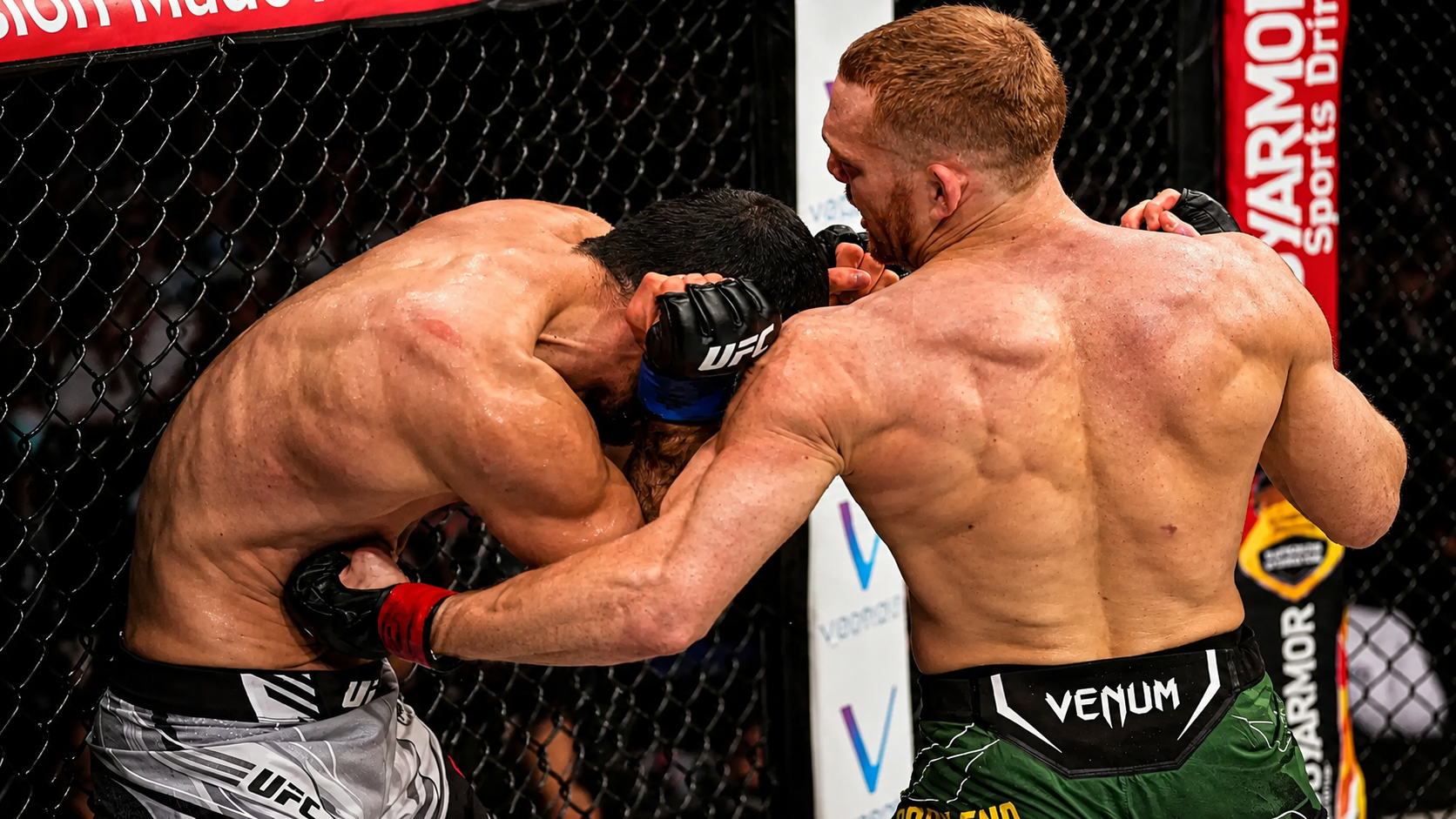
Striking volume · weight classes · 2015–2026
Put a featherweight card next to a heavyweight card and the small men look like the tape is running fast. They are throwing an extra punch roughly every 73.4 seconds. The interesting part is what happens when you count the ones that arrive.
The question
The received wisdom
The little guys move so fast, they're like watching the heavyweights on fast forward. The volume they output is way more than the heavier weights.
TLDR; Quick Facts
12.26
127.34 against 115.08 per 15 min · range 11.49 to 13.03
More significant strikes thrown by the lightest band than the heaviest, every fifteen minutes. The eye is not lying.
0.07
57.06 against 56.99 per 15 min · range −0.46 to 0.61
The difference in what they land. The range crosses zero. There is no difference to find.
49.5% 44.8%
heavy 1,734, middle 4,660, light 3,306 fighter-performances
Significant strike accuracy, heaviest band to lightest. It falls in step with weight. This is the whole mechanism.
0.67
opening rounds only · 1,122 / 3,422 / 2,580 fighter-rounds · range −1.53 to 0.19
The landed gap where both bands are watched for exactly the same 300 seconds. Still nothing. The obvious objection fails.
131.0
featherweight · 1,342 fighter-performances
Output peaks at featherweight, not at the bottom of the scale — and flyweight throws 116.1, barely more than a heavyweight.
218.1
Max Holloway · 23 fights, 423 minutes · accuracy 49.5%
The busiest man in the men's divisions. He lands at a heavyweight's accuracy, which is why it works.
132.68
women · 1,782 fighter-performances · 5.34 above the comparable men
The women throw more than anybody and are the least accurate of anybody. The gradient runs straight through them.
In short
The little guys really are busier. Every extra strike they throw misses, and the sport's weight classes differ in what they attempt rather than in what arrives. On contact, everybody lands the same.
The answer
Put a featherweight card and a heavyweight card side by side and the difference is not imagined. Across 9,700 men's fighter-performances since 2015, a fighter in the lightest band throws 127.34 significant strikes — the sport's own term for a strike counted as meaningful rather than a nudge in the clinch — for every fifteen minutes he spends in the cage, which is a full three-round fight. A fighter in the heaviest band throws 115.08. That is 12.26 more, a gap with a range of 11.49 to 13.03, and it is about as solid as anything on this site.
So the wisdom is right that the little guys are busier. It is wrong about what busier buys.
Because the same two bands land 57.06 and 56.99. Over a full three-round fight, that is a difference of 0.07 of a strike — less than a tenth of one punch — with a range running from −0.46 to 0.61, an interval sitting almost symmetrically across zero. Twelve more punches thrown. None of them arrive.
Thrown, lightest minus heaviest
+12.26
Every fifteen minutes. Range 11.49 to 13.03 — nowhere near zero.
Landed, lightest minus heaviest
+0.07
Range −0.46 to 0.61. The interval contains zero, so there is no difference here to report.
Two featherweights show what the gap is worth. Max Holloway throws 218.1 significant strikes every fifteen minutes; Sean Strickland throws 213.9, near enough the same work. Holloway lands 107.9 of his. Strickland lands 91.5. Same output, sixteen fewer arriving — and that difference is the whole subject of this page, shrunk to two men.
Every division, drawn twice
Here is every men's division in the sport, drawn twice. The pale bar is what that division throws. The bright bar inside it is what that division lands. The pale bars fan out as the fighters get smaller; the bright bars stop in almost exactly the same place.
Landed Thrown and missed
Heavyweight
113.2
56.3
Light heavyweight
117.0
57.7
Middleweight
118.7
56.0
Welterweight
121.8
55.5
Lightweight
128.0
58.9
Featherweight
131.0
59.3
Bantamweight
129.9
57.9
Flyweight
116.1
51.4
0per fighter, per 15 minutes of cage timethrown
landed
Men's divisions only. Significant strikes, 2015 onward, computed per fighter over summed cage time — heavyweight fights are shorter because they end, so a per-fight count would flatter the lighter divisions for a reason that has nothing to do with how they fight. It holds for every strike, not only the ones counted as significant: total strikes thrown run 152.29 against 140.90, and total strikes landed come back at 78.36 against 79.33 — 0.98 the heavy band's way on a range of 0.35 to 1.61, worth about one and a quarter per cent.
Two things in that picture are worth more than the headline.
The first is that output peaks at featherweight and not at the bottom of the scale. The curve climbs steadily from heavyweight through to 131.0, and then it falls off a cliff.
The second is what it falls off into. Flyweight — the smallest men in the sport, the division the received wisdom is most confident about — throws 116.1, which is barely more than a heavyweight, and lands 51.4, which is the lowest figure of any division on the board. The fastest-looking men in the sport are, on the feet, among the least busy.
They are not idle. They are wrestling: flyweight spends 19.8% of its cage time in control — meaning holding the other man down or pinned — the largest share of any men's division, against heavyweight's 18.1%. The lightest division on the card is the one most committed to the floor, and every second spent there is a second not spent throwing.
The obvious objection
This is the first thing anybody says, and it is a good objection. Heavyweights finish each other. If the big men are only watched during short, violent fights, then a per-minute rate is comparing the heavy band's most explosive minutes against everyone else's ordinary ones, and the flat landed figure could be an artefact of who got watched for how long.
There is one place in this data where that cannot happen: the opening round of a fight that reached round two. Every one of those is exactly three hundred seconds long. Nobody is observed for longer than anybody else, and no stoppage can shorten one band's clock.
Restricted to those 1,122, 3,422 and 2,580 fighter-rounds, both halves of the finding survive. The lighter men still throw more — 114.14 against 105.95, a gap of 8.20 on a range of 6.93 to 9.46. And they still land nothing extra: 50.03 against 50.70, which is 0.67 the other way with a range from −1.53 to 0.19. The interval contains zero.
Decision fights tell the same story from the other end. Over 634, 2,134 and 1,760 fighter-performances that went to the judges, the light band throws 126.37 against 112.34 — a gap of 14.03 — and lands 55.52 against 53.70. That last one is 1.82 in the light band's favour on a range of 1.17 to 2.47, so it does clear zero. It is worth about three per cent, and it points the opposite way to the total-strikes figure a few paragraphs above. Neither is a finding; both are printed because leaving them out would be the dishonest choice.
Difference per 15 minutes · lightest band minus heaviest
Thrown, all fights +12.26
Lighter men throw more
Landed, all fights +0.07
No difference
Thrown, equal-length opening rounds +8.20
Lighter men throw more
Landed, equal-length opening rounds −0.67
No difference
Men's divisions only. The two rows in bone contain zero, which is the finding rather than a failure to find one.
Eleven years, three windows
The clock is one way the finding could be an accident. Time is the other. Split the eleven years three ways and the throwing gap points the same direction every time. The landing gap does something more interesting: it changes sign twice.
Landed, per 15 minutes — lightest band minus heaviest, by era
2015−2018 −1.21
The big men land more
2019−2022 +1.73
The small men land more
2023−2026 −1.05
Back the other way
Every one of these clears zero, and they cannot agree which side of it they are on. Over the same three windows the throwing gap never wavers.
All three of those landed intervals clear zero. On a sample of 9,700 fighter-performances they were always going to: a gap of one strike in fifty-seven is about one and a half per cent, and an instrument this large will call one and a half per cent real. That is what statistical significance means and it is not the same thing as mattering.
The test that actually distinguishes is direction. A quantity that is genuinely different between two populations does not reverse itself twice in eleven years while its own error bars stay narrow. The throwing gap never does that — 14.35, then 14.70, then 7.52, always the same way. The landing gap cannot make its mind up, which is what a difference of zero looks like when it is measured very precisely three times.
The narrowing in the last stretch is real and worth watching. The throwing gap has roughly halved since 2019–2022, so the heavier divisions have been closing on the lighter ones for output. What they have never had to close is the gap in what lands, because there has never been one.
So the throwing gap is stubborn and the landing gap is not there. Something has to be happening between the glove leaving and the glove arriving.
The mechanism
If two populations throw different amounts and land the same amount, only one thing can be happening in between, and it is the cleanest gradient in this database. Significant strike accuracy runs 49.5% in the heavy band, 46.2% in the middle and 44.8% in the light — down at every step, in exact step with weight.
Percentage points below heavyweight
Heavyweight
49.7%reference
Light heavyweight
49.4%−0.3
Middleweight
47.2%−2.5
Welterweight
45.6%−4.1
Lightweight
46.0%−3.7
Featherweight
45.3%−4.4
Bantamweight
44.6%−5.1
Flyweight
44.3%−5.4
Women's divisions
44.4%−5.3
heavyweight, the reference5.4 points covers the whole sport
Bars are points BELOW the heaviest division, not absolute accuracy — the whole sport fits in 5.4 points, and an axis starting anywhere near the minimum would overstate that as a chasm. One inversion, and it is honest to name it: lightweight sits at 46.0%, slightly above welterweight's 45.6%. Every other step goes the same way. The women's row is the comparison made properly in the section below.
That is what the eye is actually registering. A fifteen-minute featherweight fight contains more punches than a fifteen-minute heavyweight fight, and the extra ones are the ones that miss. Speed shows up in the count of attempts, because attempts are cheap; it does not show up in the count of arrivals, because arriving is a different problem.
Inside a single fight the same trade has a winner, and that is a different piece of work — the man who out-throws his opponent while being out-landed by him loses far more often than he wins. This one is about divisions, and it names no winner at all.
It is worth saying what this is not. It is not evidence that heavyweights are better strikers, and nothing here measures how hard anything landed. A heavyweight's target is larger, slower, and harder to move out of the way. The gradient is at least as much about what is being hit as about who is hitting it.
23 fights, 423 minutes

If the received wisdom had a face it would be Max Holloway. Twenty-three UFC fights since 2015, four hundred and twenty-three minutes in the cage, and 218.1 significant strikes thrown for every fifteen of them. Nobody with a sample that size comes close. He is a featherweight, which is precisely the fighter people are picturing when they say the little guys never stop, and he throws 66.5% more than the division around him.
So the wisdom picks its champion correctly. It just misreads why he wins.
Holloway's accuracy is 49.5%. That is not a featherweight's number — his division averages 45.3% — it is a heavyweight's, to the decimal. He lands 107.9 per fifteen minutes, nearly double what his division manages, and he gets there by combining the output of the lightest end of the sport with the connection rate of the heaviest. Nobody else in the record does both.
The control is standing directly behind him. Sean Strickland has the same twenty-three fights and throws 213.9 — within touching distance of Holloway's volume, over three hundred and eighty-seven minutes. He lands 91.5, at 42.8%. Same work rate. Sixteen fewer strikes arriving every fifteen minutes.
Men and women
Women's bouts are excluded from every figure above, and deliberately: the women's divisions sit at the light end of the scale, so comparing them against all men would put a sex effect and a weight effect in the same column. This site has been caught by that before, on reach. The comparison that means anything is women against men of comparable weight — the light band, which is featherweight, bantamweight and flyweight.
Across 1,782 fighter-performances and 22,450 minutes, the women throw 132.68 significant strikes per fifteen minutes. That is more than any men's band in the sport, and 5.34 above the comparable men on a range of 4.61 to 6.07. Their accuracy is 44.4% — below every men's division except flyweight, which sits fractionally lower at 44.3%.
Which is the story continuing rather than breaking. Throw more, connect less: the women extend both gradients past the point where the men's divisions run out, and they sit at or below the men's light band on weight, so that is exactly where the pattern predicts they would land.
Where they differ is small and real. The women land 58.97 against the comparable men's 57.06 — 1.91 more, on a range of 1.42 to 2.40. That is about three per cent, the same order as the decision-fight and total-strike differences this page has already declined to make anything of, and consistency requires treating it the same way. It is a hair, it clears zero, and it is not a mechanism.
The comparison people reach for first is the one to avoid. Set against the heaviest men rather than the comparable ones, the women's throwing gap inflates to 17.60 — more than three times the honest figure. Almost all of that is weight, not sex.
Difference per 15 minutes · women minus men
Thrown, against comparable weight +5.34
The women throw more
Landed, against comparable weight +1.91
Real, and worth about three per cent
Thrown, against the heaviest men +17.60
The unfair comparison, shown for contrast
The third row is what you get by comparing women against the wrong men. It is three times the size of the second-row comparison and almost all of the excess is weight.
What this means for your training
You are already throwing more than the men two bands above you. It has bought your division nothing. The arithmetic below uses your own division's frozen figures, so you can check it.
A featherweight throwing his division's 131.0 at his division's 45.3% lands 59.3. Raise the accuracy to a heavyweight's 49.7% — 4.4 points, without throwing one extra strike — and he lands 65.1. To buy that same 5.8 by volume alone he would have to throw 12.8 more every fifteen minutes, which is more than the whole 12.26 gap separating the lightest band in the sport from the heaviest. The cheaper lever is not the one you are pulling.
"He is high volume" is not information below welterweight, it is the baseline — everyone there throws between 116.1 and 131.0. The number that separates opponents is accuracy, and it spans 44.3% to 46.0% across those same divisions before you get to the individual. Pull the accuracy column first and read the volume column second.
Your division throws 116.1, barely above heavyweight, and spends 19.8% of the fight in control — more than anyone. The output ceiling at flyweight is a floor-time ceiling, so the honest question is not how to throw more but whether the grappling exchange you spent that minute on was worth more than the exchange you did not have. For a lot of flyweight fights the answer is yes, and this page has nothing to tell you.
Everything on this page that clears zero by one or two strikes. The women's 1.91, the decision-fight 1.82, the total-strike 0.98: all three are real on a sample this size and all three are worth around two or three per cent, and two of them point in opposite directions. Do not build a camp on a number that a different four-year window would have handed you with the opposite sign.
One honest limit. Nothing here measures how hard anything landed, so "lands the same" means the same count of significant strikes, not the same damage. A heavyweight's 56.99 and a featherweight's 59.3 are the same number and very plainly not the same fifteen minutes.