Fight Stats · Submissions
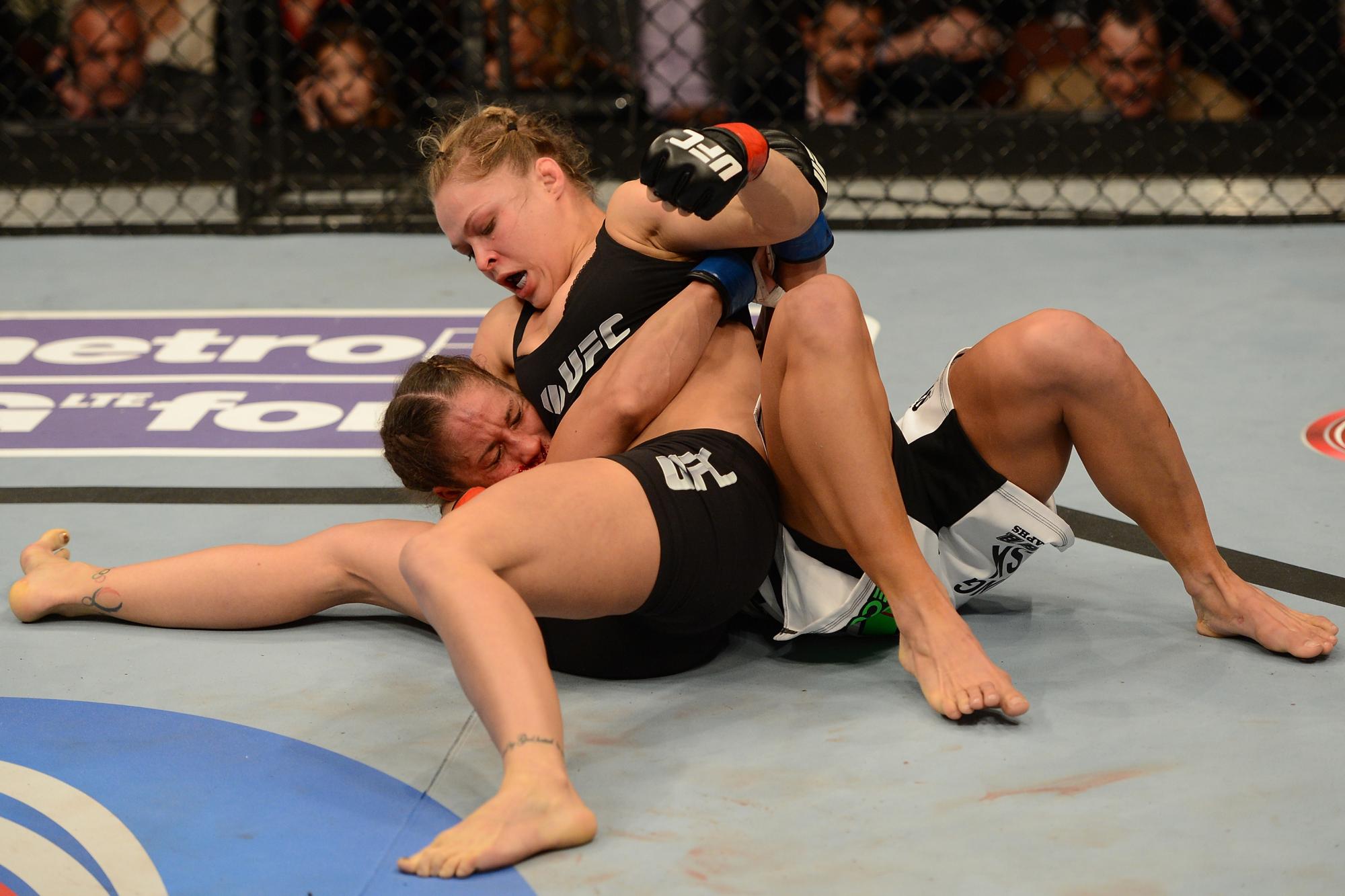
The armbar belongs to the women
Women finish fights by submission at precisely the rate comparable men do — 19.1% against 19.2%. What they do not share is the target. One game hunts the neck. The other hunts the arm, and it is the only place in this database where the two sports genuinely part company on the mat.
Do women actually submit people differently, or does it just look that way?
Differently, and by a lot. Arm submissions end 6.39% of women's fights against 2.41% of men's at comparable weight — more than two and a half times as often, on an interval running from 2.05 to 5.90 percentage points that never approaches zero. This is not a sample-size illusion and it is not weight in disguise. It is the clearest divergence between the men's and women's games that this database contains.
Almost every finding on this site ends with the two sports agreeing. The value of a takedown, the split-decision rate, what ageing costs a fighter, the way a knockdown does or does not end a fight — men and women land on nearly identical numbers, often to within a tenth of a point. It is one of the quietly remarkable things about the data.
Submissions are where that stops. Not in how often they happen, which is the part that matches almost eerily well, but in what gets attacked when they do.
The same total, built from different parts
Two stacks, one height
Submissions per 100 fights, 2015 onwards, split by what they attacked. Both columns are drawn to the same scale. The women's game is on the left, men of comparable weight — flyweight and bantamweight — on the right.
Women
845 fights · 161 submissions
Men, fly & bantam
912 fights · 175 submissions
Segment heights are each region's share of that column's submissions. The two columns are drawn to the same total because the two submission rates — 19.05% and 19.19% — differ by 0.14 of a point, on an interval from −3.8 to +3.5. Compared against men of comparable weight rather than all men, because women fight only in the lighter classes.
Share of all submissions that attack an arm. The difference is 21.0 points, on an interval running from 12.2 to 29.8.
Why this one is real when others weren't
This site has been wrong about a men-versus-women gap before. Reach looked like it diverged by sex, and it didn't — it diverges by weight, and women fight only at the light end, so the two got confused. That failure is the reason every comparison here now runs against men of comparable weight before it runs anywhere near a headline.
The armbar gap survives that test and then some. Against men's flyweight and bantamweight it is 6.39% versus 2.41% of fights, a difference of 3.98 points with an interval of 2.05 to 5.90. Against all men's divisions it is wider still, 6.39% against 1.63%. Narrowing the comparison to the fairest possible control shrinks the gap and leaves it standing comfortably clear of zero.
And it is not one fighter or one good year. Fifty-eight arm submissions spread across thirteen seasons, and no woman in UFC history has more than three. Ronda Rousey has three. Mayra Bueno Silva has three. Mackenzie Dern has three. Then a run of five fighters on two. This is not a specialist's signature showing up in the aggregate — it is a habit that belongs to the population.
Fifty-three of the fifty-eight are armbars. Not a family of arm attacks — one technique, over and over.
There is a second half to the finding that is easy to miss. Women don't only attack arms more; they attack necks less. Neck submissions end 12.07% of women's fights against 16.12% of comparable men's, a difference of −4.05 points on an interval from −7.29 to −0.80. That also clears zero. The two sports are not running the same submission game with a bonus armbar bolted on. They are aiming at different things with the same frequency.
The origin
The women's era opens with an armbar
The emblem
She is the origin and she is still the joint record

Three armbars, and they bracket the story rather than sitting inside it. Liz Carmouche at UFC 157 in February 2013 — the first. Miesha Tate at UFC 168, the only one to survive into a third round. Cat Zingano at UFC 184 in February 2015, back to the first round again.
Thirteen years later nobody has beaten that. Mayra Bueno Silva has three. Mackenzie Dern, who arrived as a world-champion grappler, has three. Rousey got hers in a twenty-five-month window and then never fought to a submission again.
The reason she matters to this story is not that she is famous for the armbar, though she is. It is that she demonstrates the thing the rest of the data says: the technique was never waiting for the women's game to develop into it. It was there in the first fight, at full strength, before there was a division to be typical of.
What has changed since is only how many people do it. Rousey's three came from a specialist doing one thing better than anyone. The fifty-five since have come from everybody.
No single owner
Nobody has more than three
When a technique dominates one population and not another, the first thing to check is whether one or two extraordinary athletes are carrying the entire number. In the men's leg-lock data that is exactly what happens — four of the eleven heel hooks since 2015 belong to a single heavyweight.
Here it doesn't. The top of the women's armbar list is a three-way tie, followed by five fighters on two, followed by a long tail of one apiece. Remove all three joint leaders entirely and the gap against comparable-weight men still clears zero.
That is what makes this a finding about a sport rather than about a roster. Mackenzie Dern arriving as a world-champion grappler did not create the pattern; she joined one that was already there when she got to the UFC in 2018, and that had been there since the opening bout of the opening night.
Most arm submissions, women's divisions
 Mayra Bueno Silva2018–20223
 Mackenzie Dern2020–20253
 Paige VanZant2015–20192
 Cortney Casey2016–20202
 Gillian Robertson2017–20232
 Montana De La Rosa2017–20192
All armbars. Polyana Viana also has two. 58 arm submissions in the women's divisions since 2014, 51 of them from 2015 onwards. Every year since 2014 has at least one.
What might be causing it
The database establishes the gap. It cannot establish the mechanism, so what follows is reading rather than evidence — but two candidates fit the shape of it.
The first is the guard. The armbar is fundamentally a bottom-position attack, and the men's game has spent two decades making the bottom a worse place to be, as strikes from the top became more punishing and referees more patient with ground-and-pound. The men's armbar collapsed alongside that shift — from 98 finishes before 2015 to 48 after. If the women's game applies less damage from the top, the guard stays a live attacking position rather than a survival one, and the submission that lives there stays live with it. The knockout data points the same way: women finish by KO at well under half the men's rate.
The second is simply the back. A rear naked choke needs you to take and hold someone's back, which is a wrestling and scrambling problem before it is a submission problem. If back-takes are harder to convert and hold, the neck game shrinks and the arm game fills the gap — which is precisely the trade the two columns above show.
Both are plausible. Neither is proven here, and a reader should treat them as hypotheses that happen to fit a very well-evidenced gap.
Men and women
The comparison, in full
This story is the men-versus-women section, so here is the whole comparison in one place rather than a summary of it — including the parts that match, which matter as much as the part that doesn't.
The submission rates land within a seventh of a point of each other, which is as close to a match as this database gets: whatever it is that determines how often a fight ends on the mat, it is operating identically on both sports. The leg rates match too. What diverges is the split between neck and arm, in both directions and both clear of zero.
One honest limitation. The women's game is 845 modern fights against the men's 4,603, so every women's figure here carries a wider interval than its counterpart. That is why the comparison runs against 912 comparable-weight men's fights rather than the full men's set — it costs statistical power to gain a fair control, and in this case the finding is large enough to pay for it.
Per fight, 2015 onwards
Women's divisions (845 fights) against men's flyweight and bantamweight (912 fights).
What it changes
Two sports, two defensive budgets
If you corner in the women's divisions and you are working from a men's submission-defence template, you are mis-allocating. In the men's game, arm attacks are roughly one submission in eight and the sensible response is to weight defensive time heavily toward the neck. In the women's game they are one in three. Armbar defence — posture in guard, elbow position, the hitchhiker escape, arm-in survival — deserves something close to double the share it gets in a men's camp, and the time comes out of the choke work, not out of the striking.
The reverse holds just as firmly and gets said far less often. If you are preparing a man at flyweight or bantamweight, arm submissions account for 2.4% of fights. That is not zero, but it does not justify the volume of armbar-defence drilling that the technique's fame attracts. Thirteen percent of the submission threat is not worth thirty percent of the mat time.
For the attacking side, the useful reframe is that the women's numbers are evidence the guard is still a scoring position in that sport. Fifty-eight arm finishes in thirteen years, none of them by a fighter with more than three, means this is not a specialist's weapon that needs a world-champion grappling background to use. It is being landed by the general population at a rate the men's divisions have not reached since 2006.
One thing not to do: read this as a claim about how the two sports rank. Both submit at about 19.1%. Nothing here says one game is better on the mat than the other — only that they are pointed at different parts of the body, and that a camp built for one of them will be defending the wrong limb in the other.