14.3–19.6%
every year since 2014 · 18.6% in 2026
Submissions are not dying out. The long fall stopped more than a decade ago and the share has sat in the same narrow band ever since.
Submissions · 8,834 bouts · 1994–2026
The oldest promise in this sport is that you can win a fight flat on your back. Submissions have not declined in a decade — but the armbar finishes about a quarter as often as it once did, and the choke from the back has not moved at all. Unless the fighters are women.
The question
The received wisdom
Submitting a formidable opponent off your back is the ultimate leveller in mixed martial arts. Even if you are stuck on the bottom and being dominated, you can still win the fight.
TLDR; Quick Facts
14.3–19.6%
every year since 2014 · 18.6% in 2026
Submissions are not dying out. The long fall stopped more than a decade ago and the share has sat in the same narrow band ever since.
4.74 → 1.32
armbars per 100 men’s bouts · interval −4.53 to −2.32
But the armbar has collapsed. Before 2011 it ended nearly five bouts in every hundred; since then, barely more than one.
3.03 → 0.99
triangles per 100 · interval −2.94 to −1.15
And so has the triangle. The two finishes that defined this sport’s first twenty years, both taken from underneath, both down by two thirds.
7.38 → 7.46
rear naked chokes per 100 · interval −1.39 to +1.54
Here is the row that does nothing, and it is the whole finding. Over three decades the choke from the back is exactly as productive as it always was.
1.84 → 2.82
arm triangle, D’Arce and anaconda combined · +0.19 to +1.76
What grew instead are the chokes you take from on top or out of a scramble. Not one of them is taken from underneath.
6.22 — 1.18
armbars per 100 since 2013 · women — men
Except in the women’s divisions, where the armbar never went anywhere. A gap of five points, on an interval from +3.46 to +6.61.
36.3% → 43.1%
submissions logged with no position at all
One honest note. The obvious way to test this — by recorded position — cannot be trusted, because the record keeping got vaguer. This page rests on the names of the holds instead.
In short
Submissions are not dying. One position is. The armbar and the triangle have collapsed while the choke from the back has not moved at all, and the finishes that replaced them are all taken from on top. The guard did not stop working — in the women’s divisions it still produces armbars at five times the men’s rate. It stopped being used.
Submissions ended 64.5% of bouts in the UFC’s first year. By the mid-2010s it was about a fifth, and there it stopped: every year since 2014 has landed between 14.3% and 19.6%, with no trend inside that band. In 2026 it is 18.6%. On the face of it, nothing is happening.
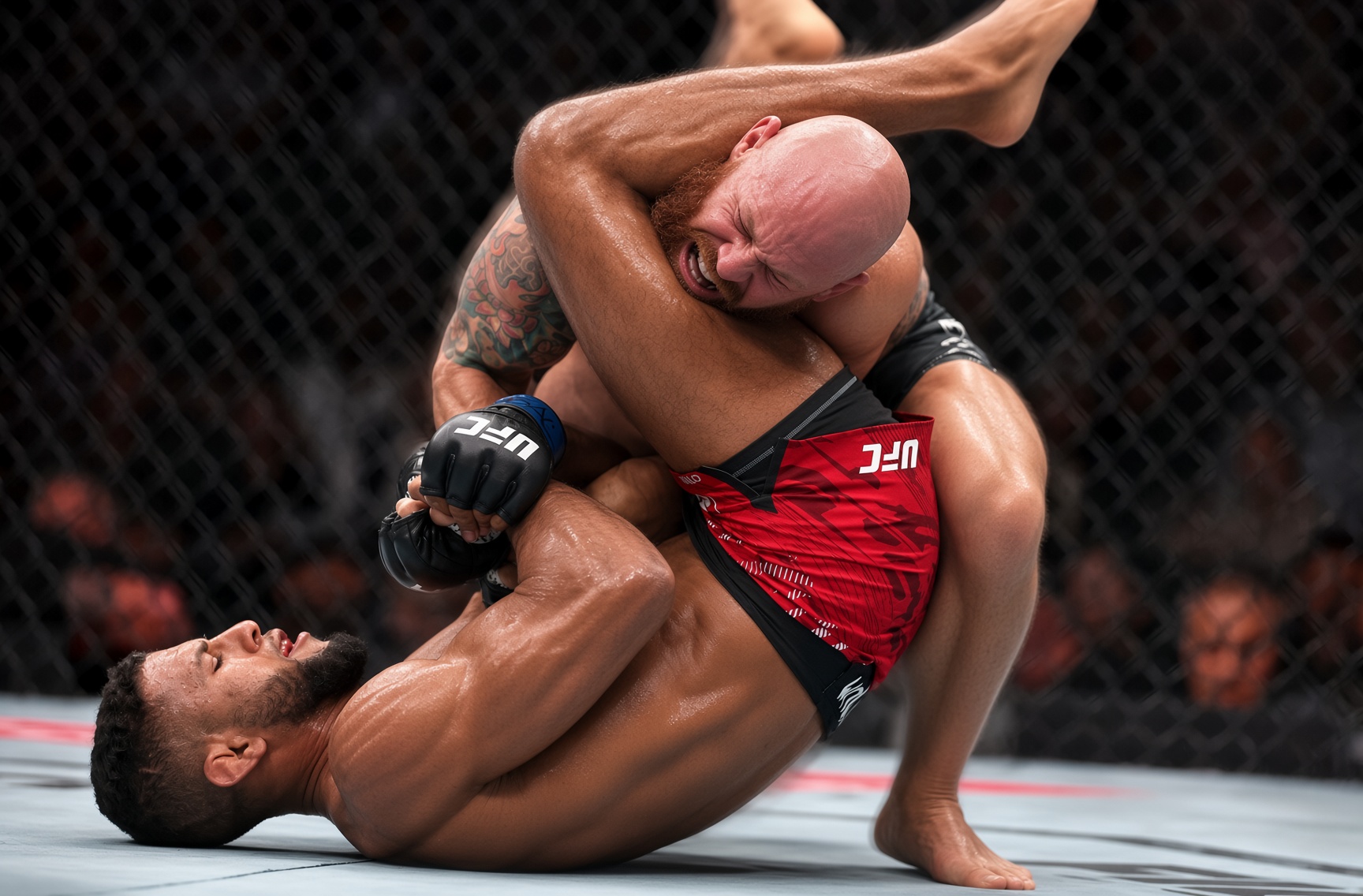
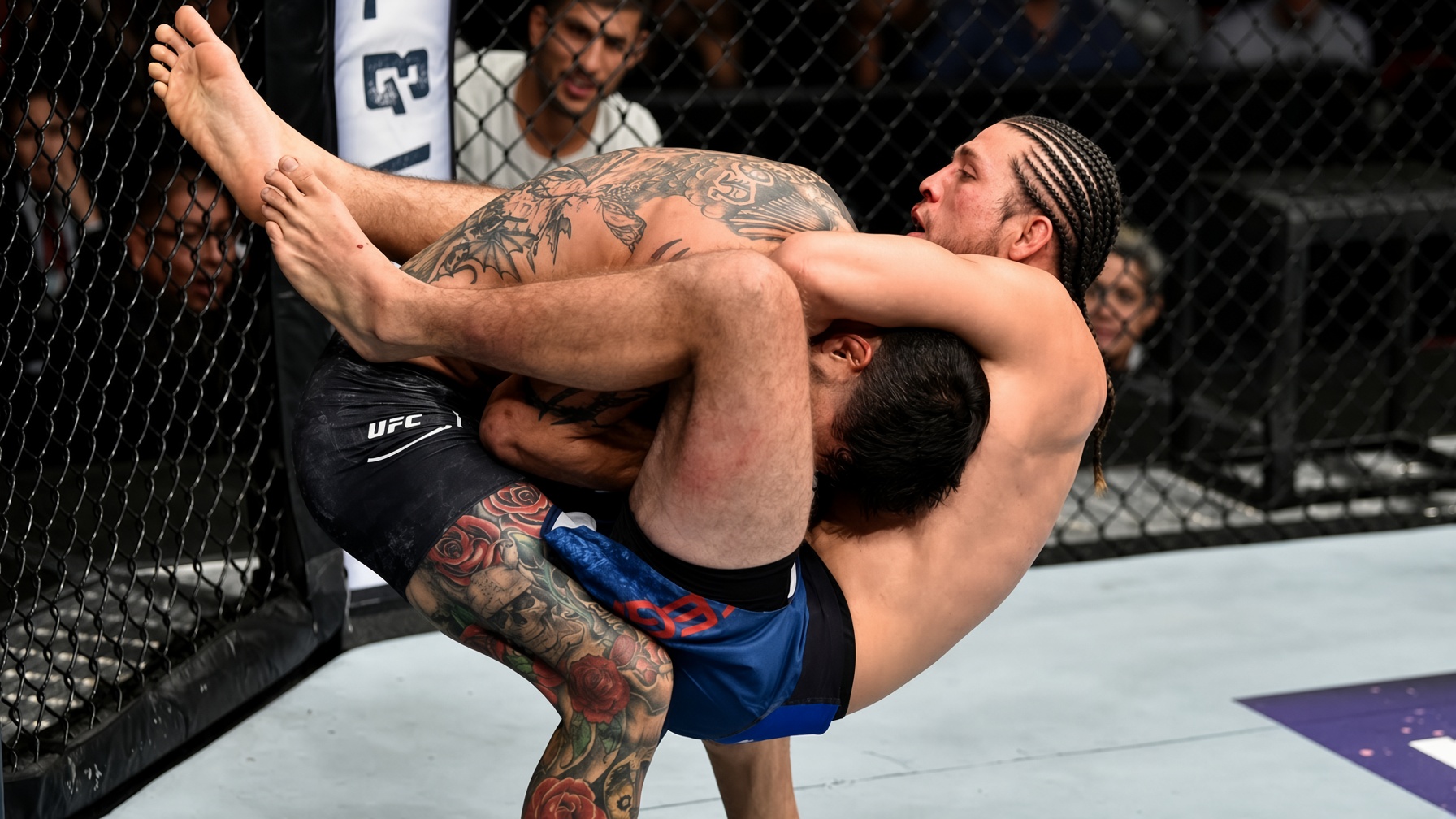
Underneath that flat total, something is. The submission that made this sport’s reputation — the one where the fighter losing the fight, pinned on his back with a bigger man on top of him, reaches up and takes an arm — has been quietly leaving.
Armbar, triangle, choke from the back
+0.08
The change in rear naked chokes per 100 men’s bouts between this sport’s first seventeen years and its last fifteen. Interval −1.39 to +1.54. Thirty-two years, 8,834 bouts, and the most common finish in the sport is doing exactly as much work as it did in 1994. Everything below is about what happened to the two beside it.
| Submission | 1994–2010 | 2011–2026 | Difference | Verdict |
|---|---|---|---|---|
| Armbar | 4.74 | 1.32 | −3.43 [−4.53, −2.32] | Fell |
| Triangle | 3.03 | 0.99 | −2.04 [−2.94, −1.15] | Fell |
| Rear naked choke | 7.38 | 7.46 | +0.08 [−1.39, +1.54] | No change |
That is 1,518 men’s bouts before 2011 against 6,383 from 2011 onward.
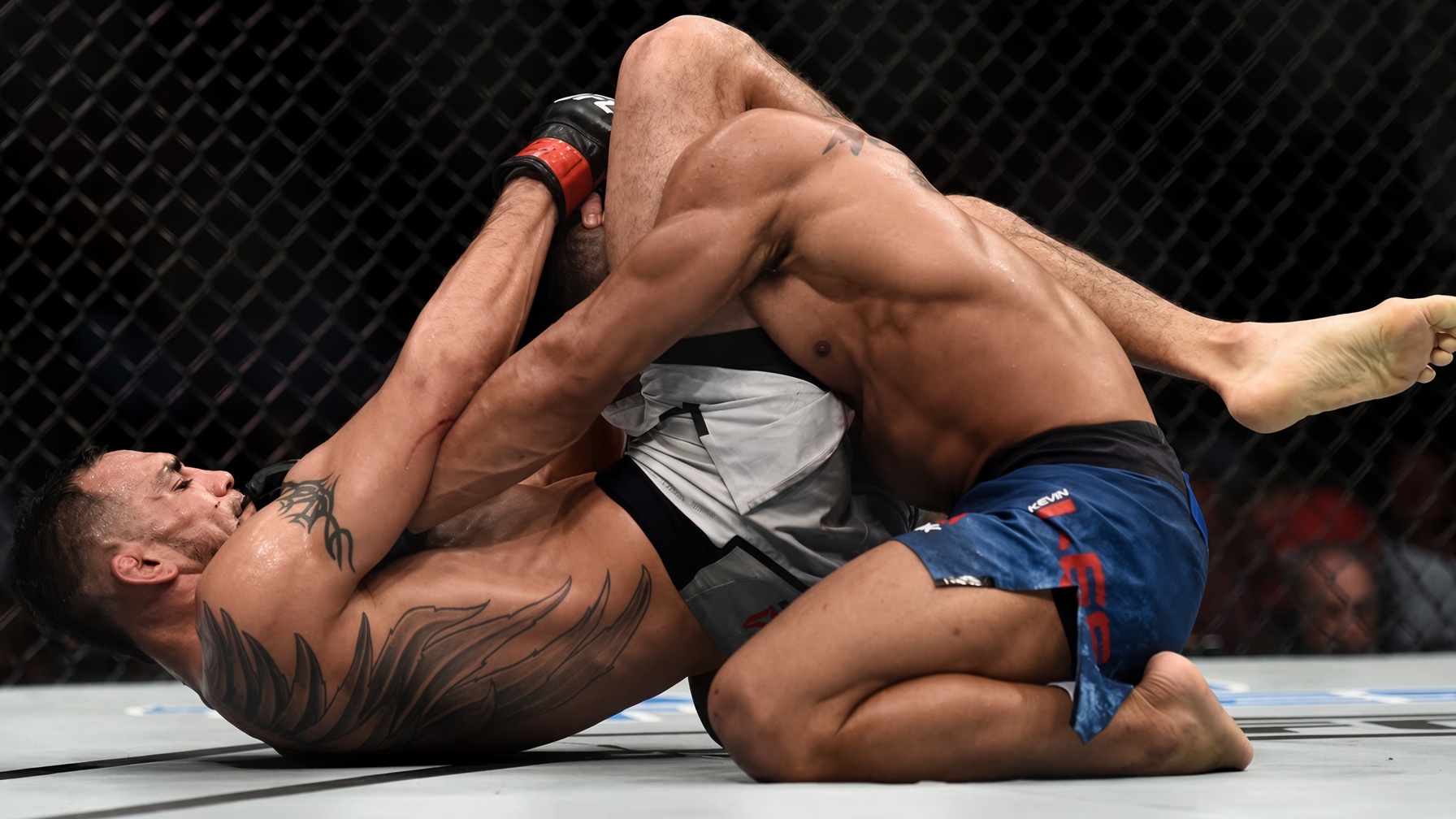
The armbar and the triangle are the two great submissions of the guard — the attacks you throw from underneath. Both have lost roughly three quarters and two thirds of their rate respectively.
As a comparative benchmark, the rear naked choke is another submission staple that's been around since the very beginning. Across three decades and 8,834 bouts, the most common finish in the sport is doing exactly as much work as it did in 1994. Not declining, not growing. Unchanged.
Five-year rolling rate, 1994–2026
Submissions per 100 men’s bouts
Five-year centred rolling average · 1994–2026 · two panels, two scales
The upper panel is every submission, whatever the type. It fell from 45.16 per 100 men’s bouts in 1995 to 16.95 today, and most of that drop was over by 2011. That is the backdrop the three submissions have to be read against.
Read against it, the three say different things. The rear naked choke sits at 7.11 — almost exactly where it sat thirty years ago, which means it now accounts for a far larger share of a much smaller total. The armbar peaked at 7.78 in 1996 and is at 0.86. The triangle is at 0.51. Those two did not merely shrink with the sport; they shrank while the choke beside them did not move at all.
The dashed line running out of 2011 under each series is the level it held that year, carried forward. The rear naked choke finishes above its own line: 6.63 then, 7.11 now. The armbar and the triangle finish a long way under theirs — 2.50 down to 0.86, and 1.89 down to 0.51. Submissions of every kind went 19.95 to 16.95 over the same stretch, a fall of about a sixth, against roughly two thirds for the armbar. Those are readings off a smoothed line rather than tested differences; the tested ones, with their intervals, are in the tables.
A five-year window rather than single years, because a submission that finishes thirty fights a year is far too noisy annually — one busy card would look like a trend. Every difference quoted on this page carries a 95% confidence interval.
Arm triangle, D’Arce, anaconda
If the guard submissions stopped finishing so many fights, then what took their place? Three submissions answer this call - the arm triangle, the D’Arce and the anaconda — all chokes and none of them from the guard. They are not one position, and they do not all begin the same way. What they have in common is the position they are not taken from: none of them comes from underneath. You arrive at them from the top, or out of a scramble nobody has won yet.
Change in finishes per 100 men’s bouts · 2011 onwards, against 1994–2010
Armbar −3.43
Clears zero
Triangle −2.04
Clears zero
Guillotine −1.00
No change
Rear naked choke +0.08
No change
Arm triangle, D’Arce, anaconda +0.98
Clears zero
← fellgrew →
Each bar is the range the true change could plausibly sit in. If the bar crosses the line, the honest answer is that we cannot tell it apart from nothing at all. Five holds, one axis. The two taken from underneath are the two that fall clear of the line; the family taken from on top is the one that clears it going the other way. And the choke from the back sits across zero, which is the honest way of saying that in thirty years it has not moved. 1,518 bouts before the split against 6,383 after.
2016 The year these chokes overtook the armbar and the triangle combined, on a five-year rolling rate. They have finished more fights than both classical guard submissions together in every year since.
| Submission | 1994–2010 | 2011–2026 | Difference | Verdict |
|---|---|---|---|---|
| All three combined | 1.84 | 2.82 | +0.98 [+0.19, +1.76] | Rose |
| D’Arce | 0.20 | 0.69 | +0.49 [+0.19, +0.79] | Rose |
| Arm triangle | 1.19 | 1.64 | +0.46 [−0.17, +1.09] | Unproven |
| Anaconda | 0.46 | 0.49 | +0.02 [−0.36, +0.41] | Unproven |
Only the D’Arce clears our burden of proof on its own, and it more than trebled. The arm triangle and the anaconda each point upward without settling the matter — individually they are suggestive, not established. Taken together as one family, which is how they are often trained, the rise is real: +0.98 per 100 bouts.
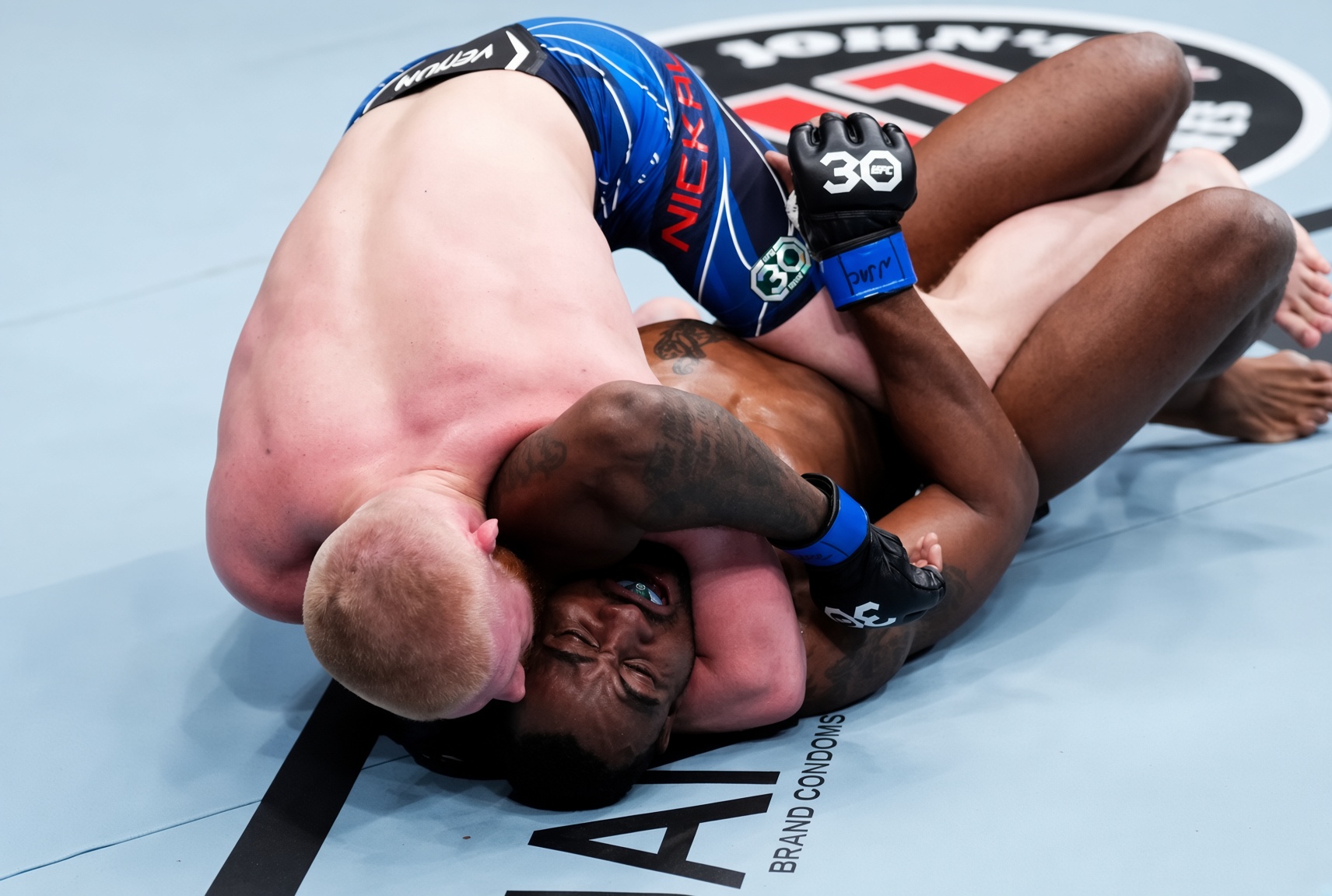
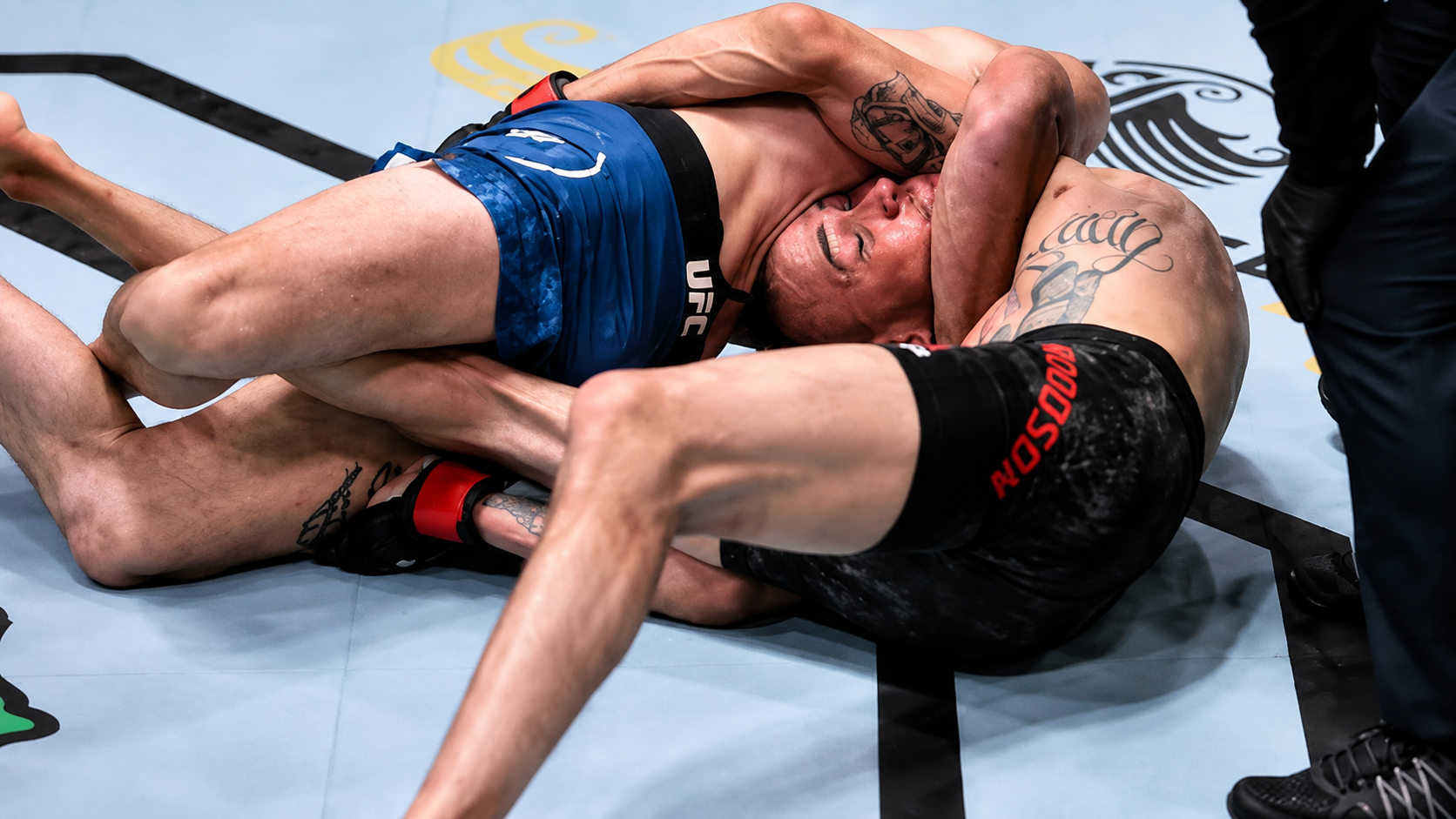
The trade is a coherent one. The sport did not stop choking people — it moved the choke from underneath to over the top, from a position you are stuck in to one you have just won.
137 started on the feet
One submission refuses to sit on either side of this. The guillotine is finished in the guard as often as anything on this page — and it has not significantly declined: 4.48 per 100 bouts before 2011, 3.48 after, a difference of −1.00 [−2.14, +0.13]. That interval spans zero. On the evidence it belongs with the rear naked choke, not with the armbar and the triangle.
The explanation is in where it starts rather than where it ends. Of the guillotines whose position is recorded, 137 began on the feet — standing, in the clinch, from a front headlock, or dropping to guard from one — against 50 from underneath. It is a choke you take on the way in and happen to finish in a guard, not necessarily a pure guard attack.
A caution on that second paragraph: 103 guillotines name no position at all, and almost all of them are recent. The 137-against-50 split describes the technique’s character, not a trend over time.
What we could not use
The obvious way to answer this is to count submissions by where the fighter was lying — “from bottom guard”. That cut shows the same collapse, and we do not use it, because the record keeping itself has changed. Submissions logged with no position at all went from 36.3% of them to 43.1%. A guard that appears to empty out could just be a scorer writing less down.
So everything above rests on the name of the submission instead, which does not depend on anyone’s wording. Coverage there is effectively complete: 1 of 1,717 submissions in the database does not say which hold finished the fight.
And 2011 is the split point because the year-by-year series flattens there, not because anything happened in the sport that year. The chart above shows the same pattern without needing a line drawn anywhere in particular.
933 women’s bouts since 2013
These stories report men and women separately whether or not they diverge. Here they diverge more sharply than anywhere else.
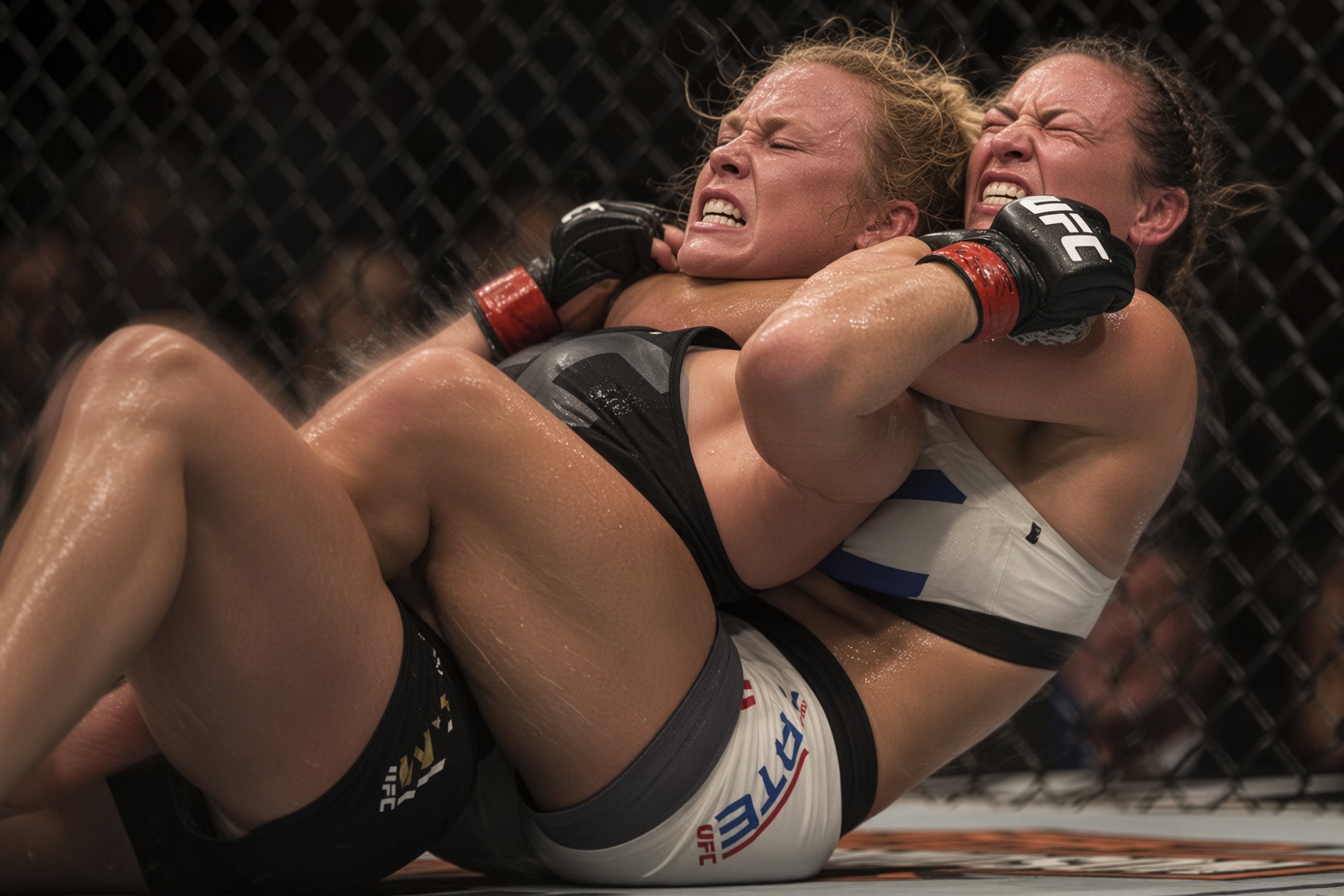
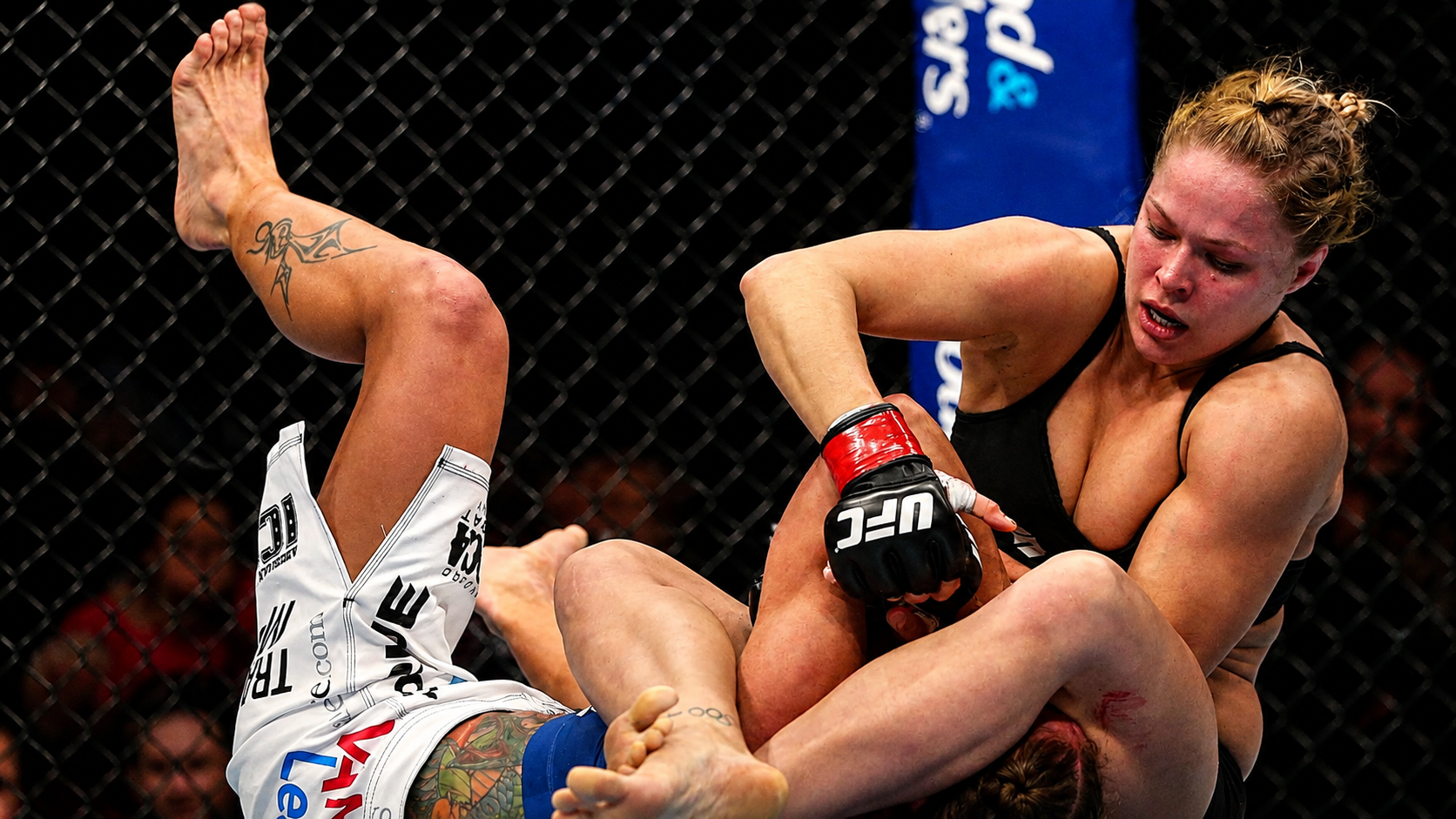
6.22 Women’s armbars per 100 bouts since 2013, against 1.18 for men over the same window — a difference of +5.03 [3.46, 6.61]. Higher than the men’s armbar rate has ever been, in any era, including the years when it was the signature finish of the sport.
Across 933 women’s bouts and 5,742 men’s since 2013, the triangle sits slightly lower for women (0.54 against 0.94) and the rear naked choke slightly higher (8.68 against 7.37). Both of those intervals span zero, so neither is a real difference. Only the armbar separates them — and it separates them completely.
So how much of that is the guard? Less than the headline suggests. Of those 58 women’s armbars, 43 name a position: 21 came from the bottom, 16 from the top — mount or side control — and 6 from the back. That is a bottom share of 49%, against 55% for men, a difference of −6.5 points [−23.9, +10.8], which spans zero. Women are not hitting armbars from underneath more often than men are. They are hitting more armbars, from everywhere.
The check that settles it is the triangle, because it cannot be taken from on top. If the women’s guard were the thing doing this work, it should be elevated too. It is not: 0.54 per 100 against 0.94 for men, a difference of −0.40 [−0.94, +0.13]. The omoplata is 0.00 against 0.03. On the two holds that can only be thrown from underneath, the women’s divisions are indistinguishable from the men’s.
So this is an armbar story rather than a guard story. The guard has gone quiet across the whole roster. What has not gone quiet in the women’s divisions is the armbar itself — from the bottom, from mount, from side control, at more than five times the men’s rate.
The limits of that: position is unstated for 14 of the 58 women’s armbars and 30 of the men’s 156, and 43 labelled finishes is a small base. This is enough to withdraw the claim that the women’s guard is alive. It is not enough to prove the opposite.
What this means for your training
This section costs training hours if it is wrong, so it is built only on the differences whose intervals cleared zero — and where a recommendation rests on something suggestive instead, it says so.
The armbar and the triangle are still real threats, but they finish roughly a quarter and a third as often as they did when most submission-defence curricula were written. A week that still splits evenly across the classical submissions is over-weighted toward those two by about a factor of three. Give that time to the back and to the top-and-scramble chokes: the rear naked choke has not lost a step in thirty-two years, and the arm triangle, D’Arce and anaconda together now finish more fights than the armbar and triangle combined.
On your back, treat the armbar and the triangle as threats rather than as plans. They still create openings — an opponent respecting the triangle postures differently, and that is worth having. But the finish behind the threat now arrives about a quarter as often as the long record of the sport would lead you to expect. The higher-percentage use of that same minute is standing up. Train the exit, use the submission to buy the space for it, and do not wait underneath for a finish the last fifteen years say is not coming.
Its decline does not clear the statistical bar, and it can be a choke started on the way in and completed in a guard rather than a guard attack — it travels with the techniques that are growing, not the ones that are going. Every sprawl and every shot you defend is a guillotine entry.
The armbar finishes women’s fights at more than five times the men’s rate, and the difference is nowhere near borderline. Defensively it deserves exactly the attention the men’s data says to withdraw — but withdraw it from the guard and spend it on the arm. Roughly a third of those armbars arrive from mount or side control, so defending one is a top-position skill as much as a bottom one.
The offensive conclusion does not reverse. On the two holds that can only be thrown from underneath, the women’s numbers look like the men’s — so there is no case here for spending more time attacking off your back than the men’s data already argues for. Drill the armbar, not the guard.