Stance · 17,012 fighter-appearances · 1993–2026
The Southpaw Problem
Every coach in combat sports says the same thing about left-handers, and the record of 2,430 UFC fights says they are right — by about three and a half points.
Do southpaws really have a natural advantage?
Yes — and it is worth about three and a half points, which is a great deal less than the folklore implies. The more useful finding is what happens when you try to work out where in a fight it comes from, because the answer is that this data cannot tell you.
Every matchup
Nine boxes, and three of them are the check
Read down the diagonal first. Orthodox against orthodox, southpaw against southpaw, switch against switch: 50.0%, three times, to the decimal.
That is not a finding, it is the receipt. When two fighters share a stance, neither can hold an advantage over the other, so the number has to come out at exactly half — and if it doesn’t, the arithmetic is broken and nothing else on the page can be trusted. Everything off the diagonal is the actual result.
Each fight counted from both fighters’ sides, so the table is symmetric by construction. Read a row as “this stance, against that one”.
Three and a half points. That is the whole of it — the entire measurable value of the oldest received wisdom in combat sports. A southpaw meeting an orthodox fighter is not entering a different sport; they are entering the same one with a small, real, persistent edge, the kind that shows up over two thousand fights and would be invisible over twenty.
Which is worth saying plainly, because the folklore does not sound like this. “Awkward”, “a nightmare to prepare for”, “nobody wants that fight” — the language implies something decisive. What the record shows is a thumb on the scale.
The interesting question is not how big the advantage is. It is where in a fight it comes from — and that turns out to be much harder to answer than measuring it was.
The obvious next question
The advantage will not tell you where it lives
If a mirrored stance works by changing the angles of a striking exchange, it should be worth more in fights that stay standing and less in fights that go to the mat. It is a clean prediction, and it is testable, and it fails.
Below is every way of cutting the 2,430 fights that might isolate the mechanism — removing submission finishes, keeping only the fights that barely touched the ground, keeping only the ones that lived there. Each is drawn with the range the sample actually supports rather than as a bare percentage, because on samples this size the difference between those two things is the entire argument.
Dot: the measured win rate. Bar: the 95% interval — the range the sample is consistent with. A bar crossing the 50% line is a subset that cannot rule out no advantage at all.
Read the bottom three rows first. The purest striking sample available — no submission finishes, less than 5% of the fight spent on the mat — comes out at 47.2%, and its interval runs from 46.9% to 54.5%. That is the subset where the striking theory should look strongest, and it is the one that cannot even establish an advantage exists.
Now read the third row. The fights that spent most of their time on the ground come out at 53.9%, comfortably clear of 50. That is the exact opposite of the prediction, and it would be just as wrong to build a story on it: 1,409 fights is enough to say the effect is there, not enough to say it is bigger there than anywhere else. Every one of these intervals overlaps every other one.
The honest finding is the one nobody wants: the advantage is real in aggregate, and this data cannot say which part of a fight it comes from.
Which is worth stating flatly, because the alternative is the thing that makes numbers untrustworthy. Slice 2,430 fights six ways and one slice will always come out lowest. Reading that slice as a mechanism — “it dies on the ground” — is a story the arithmetic does not support, however well it fits what everyone already believes.
What the tape says instead
Win rates are a blunt instrument — one bit of information per fight, which is why the subsets above run out of evidence so quickly. The per-fight statistics carry far more, and they describe a southpaw fight that looks distinctly different from the baseline even where the result doesn’t.
Baseline is orthodox versus orthodox, where both sides are the same by definition.
The last row is the one that survives. Southpaws throw less and land less, but they knock people down 13% more often — 0.235 knockdowns a fight against 0.207.
Unlike every subset above, that difference holds up when it is tested rather than just quoted. On 2,430 fights against a 9,584-fight baseline it sits 2.40 standard errors clear of zero, which is the one place on this page where the evidence is strong enough to name a mechanism.
And it is a specific mechanism. Not volume, not pressure, not a higher work rate — southpaws are behind on all three. The unfamiliar angle does not help you hit someone more often. It helps you hit them when they are not ready, which is the only kind of hit that puts anyone down.
The obvious explanation
It is not takedowns
If the edge is largest where the fight goes to the floor, the tidy answer is that southpaws get it there more often. An unfamiliar stance changes the angle of a level change as surely as it changes the angle of a cross.
It does not survive contact with the record. Across 1,391 southpaw-versus-orthodox bouts since 2015, compared inside the same fight so both men share the night, the opponent and the weight class, the southpaw lands 0.948 takedowns to the orthodox fighter’s 0.981. The difference is -0.034, and its interval runs from -0.162 to 0.095 — straight through zero.
Nor is he trying more: 2.570 attempts against 2.769, if anything the wrong way. Of the 823 bouts where the two men landed different numbers, the southpaw led in 48.7% — a coin flip, with an interval of 45.3 to 52.1. Control time differs by 0.235 seconds, which is nothing at all.
So the advantage is real on the mat and it is not built from takedowns, attempts or control. That is a harder thing to write than a mechanism, and a more honest one: the measure that would have explained it has been tested, and it says no.
Takedowns landed, per fight
0.948 vs 0.981
southpaw against orthodox · difference -0.016, interval -0.162 to 0.095
Control time
0.235s
the gap, interval -7.796 to 15.599 — through zero
Women’s bouts run separately and are not pooled: 196 of them, where the southpaw does land more (0.418, interval 0.102 to 0.734). Attempts, share of bouts and control time all touch their no-effect lines, so on one marginal reading out of several it is a lead, not a finding.
The other column
Nobody was watching the switch-hitters
Southpaws beat orthodox fighters 53.4% of the time. Fighters who switch stance beat southpaws 54.7% of the time — and beat orthodox fighters too, at 52.1%. They are the only stance in the table that is ahead of both of the others.
The sample is small enough to be careful with: 192 fights against southpaws, against 2,430 for the headline number. But the trend underneath it is not small at all. Switch-stance fighters were 1.5% of the roster between 2005 and 2011. Since 2019 they are 9.4% — a sixfold rise, while the southpaw share has not moved in thirty years.
Share of fighter-appearances recorded as switch stance, by era.
Over the same four eras the southpaw share reads 19.2%, 19.4%, 20.6%, 18.5%. Roughly a fifth of the roster, always, no matter what else changed about the sport.
The emblem
Twenty-eight wins, all of them left-handed
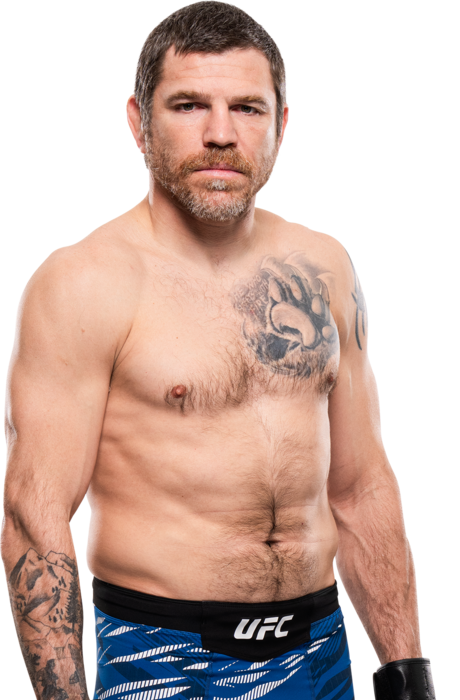
No southpaw has won more fights in the UFC than Jim Miller. Twenty-eight of them, from a career record of 38–19–0 — four clear of Demian Maia and Dustin Poirier, who are tied on twenty-two.
He is the right emblem for a story about a small edge, because a three-and-a-half-point advantage is not the kind of thing that wins you a night. It is the kind of thing that wins you a decade. Twenty-eight victories is not what an unfair advantage looks like; it is what a slight one looks like when someone keeps turning up long enough to collect on it.
Behind him the list runs Maia and Poirier on twenty-two, Rafael Dos Anjos on twenty-one, Diego Sanchez on nineteen, Francisco Trinaldo on eighteen. Four hundred and forty-seven southpaws have fought in the promotion. Six of them have reached eighteen wins.
Two things that look like findings
Does experience solve a southpaw? It should. The obvious theory is that seasoned opponents have seen enough left-handers to stop being troubled by them. Split by how many UFC fights the orthodox opponent had already had, the southpaw wins 58.8% against debutants, 53.2% against opponents with one to three fights, 49.6% against four to eight — and then 54.8% against the most experienced group of all.
That is not a curve. It goes down and then back up, on samples between 359 and 786 fights, which is what noise looks like when you want it to be a trend. The honest reading is that this data cannot answer the question.
Is it bigger in some divisions? Welterweight comes out at 58.8% and Bantamweight at 43.8%, which looks like a story about size. The two figures rest on 388 and 169 fights. Spreads that wide on samples that small are the expected amount of scatter around a three-point effect, not evidence of eight divisions behaving differently.
Stance is a label, not an observation. It is recorded once on a fighter’s profile, not fight by fight. A fighter who came up orthodox and switched in mid-career appears here as one thing for their whole record, and the 9.4% of recent appearances marked “switch” are the ones whose profile says so — not everyone who ever changed feet in a fight.
Coverage. Stance is held for 2,622 of 2,723 fighters, or 96.3%. Of those, 447 are southpaws and 153 switch. Any fight involving a fighter with no recorded stance is absent from every figure on this page.
What the diagonal proves, and what it doesn’t. Three exact 50.0% readings confirm the counting is symmetric. They say nothing about whether stance causes the difference in the other six boxes — southpaws are not randomly assigned, and who gets matched with whom is a decision somebody makes.
Men and women
The same small edge in both
A stance advantage ought to be one of the more transferable findings in the sport — the geometry of two people facing each other does not depend on the division. It behaves accordingly.
Southpaw against orthodox
2,232 fighter-performances — the sample the headline figure rests on.
Consistent, and less certain
198 fighter-performances. The difference is 1.5 points with a range of −5.8 to 8.8 — consistent, though a sample this size could not have detected a small divergence anyway.
Worth being careful about what this does and does not establish. It rules out a large difference between the two games; on 198 fights it could not have found a modest one. Given that the effect being measured is itself only three and a half points, “consistent” here means the women’s data is not inconsistent, rather than that it independently confirms anything. The knockdown mechanism the section below rests on was measured on the men’s divisions and has not been separately established in the women’s.
What this changes
Prepare for the hands, not the stance
One mechanism on this page survives being tested rather than merely quoted, and it is not awkwardness. It is damage.
The shot you don’t see
Southpaws score 0.235 knockdowns a fight against an orthodox baseline of 0.207, and that difference sits 2.40 standard errors clear of zero — the only claim here strong enough to name a mechanism. They land fewer strikes and absorb fewer. The threat is not the volume, it is the one that arrives on an unfamiliar line.
A thumb on the scale, not a different sport
3.4 points across 2,430 fights. Real, persistent, and small — roughly one fight in thirty swung. A camp that treats a southpaw opponent as a different discipline is spending like the effect is ten times bigger than it measures.
A phase-specific southpaw plan
Six different cuts of these fights — submissions removed, only the ones that stayed standing, only the ones that lived on the mat — and not one separates from the others. There is no evidence for “dangerous standing, harmless on the ground”, so a game plan built on moving the fight to a phase where the stance stops mattering is chasing something nobody has found.
Two things to hold alongside this. Stance is recorded once on a fighter’s profile rather than observed fight by fight, so a career spent switching is flattened into one label. And the stance that actually beats both of the others in this table is switch — 52.1% against orthodox and 54.7% against southpaws, on samples small enough to be careful with, but pointing somewhere worth watching.