43.9%
154 of 351 fights · baseline 35.5%, 1,935 of 5,448
Share of 2026 fights with at least one knockdown, through 22 August. The highest since 2003.
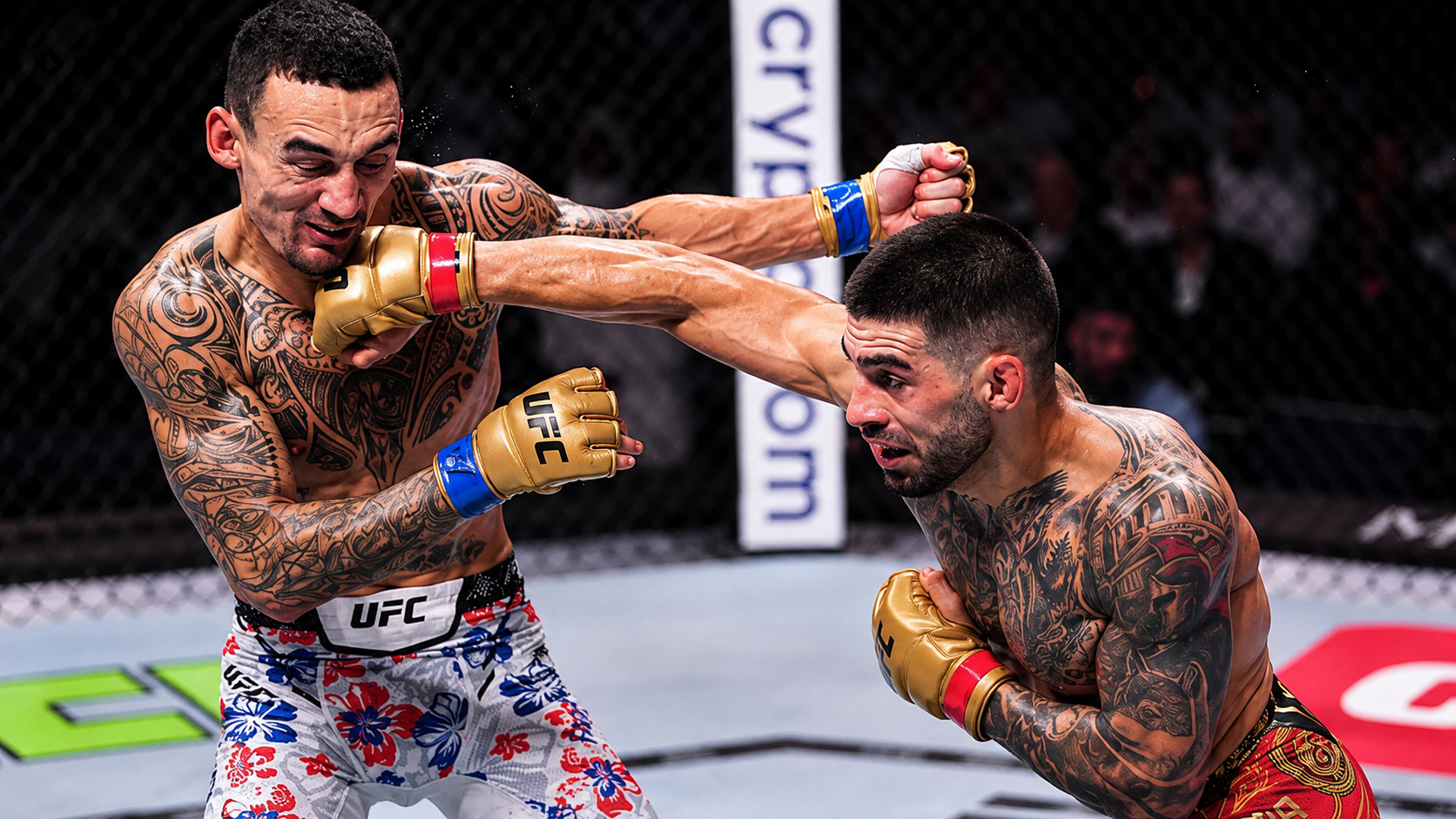
Knockdowns · 351 fights · 1 January – 22 August 2026
Through 22 August, 2026 has dropped men more often than any year since 2003 — 43.9% of fights carried a knockdown, against a 35.5% baseline. It is not the scorers being generous. It is not a heavier card sheet.
Corrected 29 August 2026: the 2015–2025 baseline figures on this page were computed against a database missing the round-by-round stats for 150 fights. Those fights have been re-imported and every baseline here recomputed. The 2026 window is unchanged; the rise is 8.4 points rather than the 9.5 first published.
The question
The received wisdom
It should be getting harder to knock people down, not easier. Every year the athletes are better prepared, better coached and better at not getting hit — striking defence is a taught skill now in a way it wasn't a decade ago. If the knockdown count is up, somebody changed their mind about what counts as one.
TLDR; Quick Facts
43.9%
154 of 351 fights · baseline 35.5%, 1,935 of 5,448
Share of 2026 fights with at least one knockdown, through 22 August. The highest since 2003.
+8.4 pts
190 knockdowns against 151 expected · 95% CI +3 to +13.7
The rise over the 2015–2025 baseline. Knockdowns per fight are up too, 0.541 against 0.43.
0.97 sd
129 knockouts against 110 expected · 1.473 per KO/TKO against a 1.367 mean
Not looser scoring. A knockdown is a judgement; a referee stopping a fight is not — and the two moved together.
0.5 of 8.4
expected 36% from 2026's own division mix at baseline rates
Not the card sheet either. Composition explains half a point of the rise; eight survive it.
7 of 9
middleweight +17.8, featherweight +15.8, heavyweight +12
Divisions up. Removing the three biggest events still leaves 41.2% of the remaining 318 fights.
−0.3 pts
women's 15.9% of 44 against 16.2% of 845 · CI −11.4 to +10.8
In the women's divisions, nothing. Forty-four fights cannot resolve it either way — but there is no sign of it.
In short
Men are hitting the canvas more often in 2026 than in any year on this record, and every ordinary explanation for it fails. The year has three and a half months left to take it back.
Share of fights with a knockdown, by year
The knockdown rate is a well-behaved number. Since 2012 it has sat between 32% and 39% in every single year, drifting nowhere in particular — up a little, down a little, and never far from where it started. It is not a statistic that trends.
Through 22 August, 2026 is at 43.9%. That is not the top of the range. It is nearly five points clear of it.
Put plainly: a knockdown used to turn up in about one fight in three. This year it is in nearly one in two.
Reach back past the modern series and exactly one year matches it. 2003, when eighteen of forty-one fights carried a knockdown — 43.90% against this window’s 43.87%. Two hundredths of a point, and a schedule of forty-one fights against three hundred and fifty-one. The UFC that produced it had eight weight classes and ran a handful of shows a year; it is the last time the sport put men down at this rate, and it did it on a fraction of the evidence.
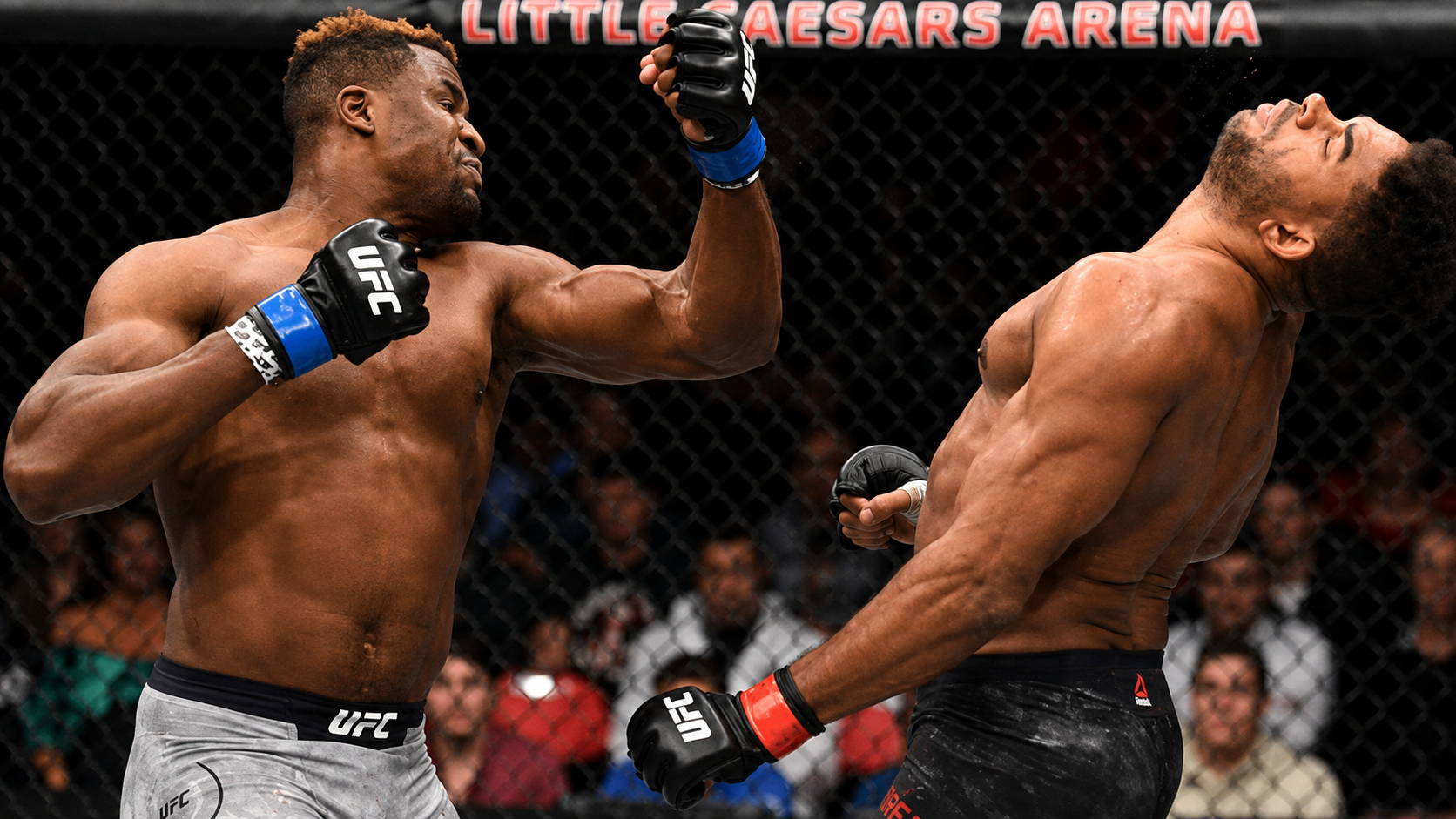
Counted as fights rather than as knockdowns it is the same story: 154 fights have carried one, where the old rate predicts 125. Twenty-nine fights that would not have had a man down in them.
A knockdown is one man's opinion
Anthony
Hernandez
3
knockdowns
by Rodrigues
and still
a decision
Gregory
Rodrigues
On 22 August in Sacramento, Anthony Hernandez and Gregory Rodrigues met, and Rodrigues put Hernandez down three times — and still needed all twenty-five minutes and all three judges to win it. It is the most recent fight in this database and it is the year in miniature: men are being dropped more often, and they are not necessarily staying down. The question is whether that is happening, or whether somebody has simply started writing it down more often.
A knockdown is a judgement. Somebody watching decides whether a man who touched the canvas was dropped or slipped, and unlike a takedown or a finish there is no bell to settle it. If the people scoring got a little looser this year, the count rises with nothing happening in the cage at all. That is the first thing anyone should ask of this number, and it is the reason the story nearly died.
It can be tested, because there is one event in a fight that nobody has to judge: a referee stopping it. So measure the knockdowns against the knockouts. If men are genuinely being hurt more often, the two rise together and the ratio between them holds. If the scoring loosened, more knockdowns get logged for each actual knockout and the ratio climbs.
It held. And the knockouts went up with it. There have been 129 KO/TKO finishes in the window where the previous decade’s rate predicts 110 — nineteen extra stoppages, on a measure with no judgement in it whatever, and the highest knockout rate since 2012 at 36.8%. Both numbers moved, in the same direction, by about the same amount. That is what a real rise looks like, and it is precisely what looser scoring does not look like: generous scoring inflates knockdowns while leaving finishes exactly where they were.
 0:08
The fastest of them. Abdul Rakhman Yakhyaev put Julius Walker down and out
eight seconds into the first round on 27 June —
a single punch to the head at distance.
0:08
The fastest of them. Abdul Rakhman Yakhyaev put Julius Walker down and out
eight seconds into the first round on 27 June —
a single punch to the head at distance.
Pictured: Julius Walker, 7-2, the man who went down. Yakhyaev has no portrait on record.
For completeness, the window’s 351 fights ended 129 by knockout, 65 by submission, 156 on the scorecards, and one that could not continue.
Heavyweights drop each other. Flyweights do not.
That kills the dull explanation. The next one is duller still, and it is the one that quietly ruins most statistics like this.
The second explanation is duller and just as plausible. Heavyweights drop each other; flyweights rarely do. A year that happens to run heavier will show more knockdowns without a single fighter behaving differently — the same trick that makes a hospital treating harder cases look worse than one that isn't.
The test is to hold the divisions still. Take 2026's actual mix of fights — how many heavyweights, how many flyweights, how many of everything else — and ask what the knockdown rate should have been if each division behaved exactly as it did across 2015–2025.
Half a point. That is the entire contribution of the matchmaking. Whatever is happening this year, it is not happening because somebody booked more heavyweights — and it is happening nearly everywhere.
| Division | Baseline | 2026 | Fights | Change |
|---|---|---|---|---|
| Middleweight | 39.7% | 57.4% | 47 | +17.8 |
| Featherweight | 38.7% | 54.5% | 44 | +15.8 |
| Heavyweight | 38% | 50% | 30 | +12 |
| Flyweight | 33.8% | 44% | 25 | +10.2 |
| Lightweight | 36.4% | 46% | 50 | +9.6 |
| Light Heavyweight | 45.5% | 51.9% | 27 | +6.3 |
| Bantamweight | 38.1% | 41.7% | 36 | +3.6 |
| Welterweight | 42.1% | 35.9% | 39 | −6.2 |
| Women’s Strawweight | 15.5% | 5.3% | 19 | −10.2 |
Twenty-eight events, and a third of the excess on three of them
Two down. The last one is the cheapest of all: maybe three good Saturdays did it.
The third explanation is that a handful of cards carried it. Twenty-eight events have run inside the window; if the excess lives on three of them, this is a story about three good Saturdays rather than about the sport.
It does not. The three biggest contributors — UFC Freedom 250, where all seven fights featured a knockdown, and the Adesanya–Pyfer and Song–Figueiredo cards at eight of thirteen apiece — hold about a third of the excess between them. Take all three out entirely and the remaining 318 fights still run at 41.2%, nearly six points clear of the baseline.
Four events tie on that measure, so which three get removed is arbitrary among equals; the answer does not move whichever three you pick.
What the year does have is nights like these. Three separate cards have carried ten knockdowns apiece — a figure no single event needs to be freakish to reach any more.
10 knockdowns
Adesanya vs. Pyfer · 8 of 13 fights
28 Mar 2026 · Seattle, Washington
10 knockdowns
Gamrot vs. Salkilld · 6 of 12 fights
8 Aug 2026 · Las Vegas, Nevada
10 knockdowns
Hernandez vs. Rodrigues · 8 of 13 fights
22 Aug 2026 · Sacramento, California
And the men doing it are not, for the most part, the names on the poster. Six fighters have scored three or more knockdowns inside the window; Gregory Rodrigues has four in two fights, and two of the six needed only a single night.
Gregory Rodrigues“Robocop” · 19-6
4in 2 fights
Carlos Prates“The Nightmare” · 23-7
3in 1 fight
Roman Kopylov14-5
3in 1 fight
Ateba Gautier“The Storm” · 10-1
3in 2 fights
Damian Pinas“The Baba Yaga” · 9-1
3in 2 fights
Daniil Donchenko14-2
3in 2 fights
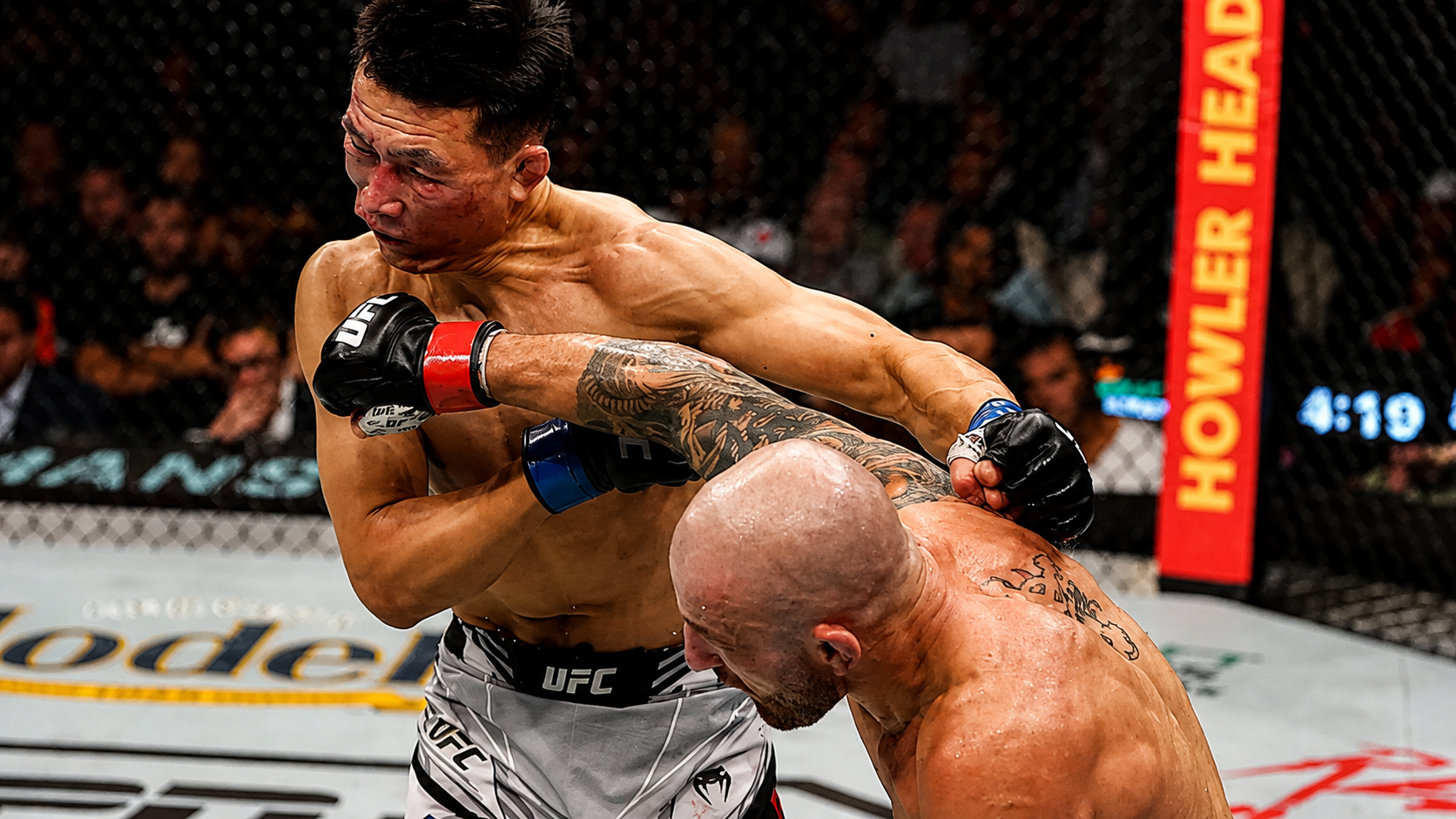
Six fights this year have carried three knockdowns. Half of them still went to the judges.
Two limits, and the second is the serious one
Two honest limits, and the second is the one that should stop anybody calling this settled.
The first is that yearly knockdown rates wobble on their own — 32.3% in 2024, 39.3% in 2012, without anything in particular happening. Measure 2026 against that wobble rather than against every fight of the last decade lumped together, and it stands 4.08 standard deviations above the mean: still the highest since 2003, and further out than the year-to-year noise can account for.
The second is that the year is not evenly loaded. Split it at 1 May and the first four months are ordinary — 38.0%, an interval that comfortably contains the baseline. Everything this story rests on has happened since.
Difference in percentage points · 2026 minus the 2015–2025 baseline
All fights +8.4
Real
Men’s divisions +8.8
Real
Women’s divisions −0.3
No evidence
January – April +2.4
No evidence
May – 22 August +13.7
Real
Forty-four fights, and an interval too wide to settle it
Everything above is a men’s story, and it took until the fifth test to notice. Split the window by division and the two halves of the roster are doing entirely different things.
Not a smaller rise. No rise. Two tenths of a point, on a baseline that was already less than half the men’s to begin with — women’s fights have always featured knockdowns at roughly 15%, and in 2026 they have featured them at roughly 15%.
The honest caveat is the sample. Forty-four fights carry an interval of plus or minus eleven points, which is wide enough to hide a real change comfortably inside it. This is no evidence of a rise, not evidence that there was none — and only the women’s strawweight division has enough fights to appear in the table above, where it sits at 5.3% against a 15.5% baseline, the largest fall of any division.
But it does mean the sentence “the sport got more violent this year” is not the one the data supports. The sentence it supports is that the men’s divisions did.
What this means for your training
This section costs training hours if it is wrong, so it rests only on the differences whose intervals cleared zero — the men’s rise and the May-onward rise. Where it leans on something suggestive instead, it says so.
The probability that a given men’s fight contains a knockdown has moved from roughly one in three to nearly one in two — 39.1% to 47.9%. Most camps drill getting dropped as a finish: the corner throws the towel, the round ends, the exercise stops. The likelier experience in this year’s data is that you get hurt, you survive, and there are eleven minutes left with a scorecard to repair. Hard rounds should sometimes begin with a fighter already compromised and asked to win the next four minutes from there.
Sixty seconds is not long enough to invent one. Three of this year’s six three-knockdown fights went to the judges, which means the corner’s job was not to decide whether to stop it — it was to rebuild a game plan and explain a scorecard under a clock. What changes, what gets abandoned, and what the fighter is told about where the fight now stands should be decided in the gym, not in the chair.
Half of the three-knockdown fights this year went the distance, so half the fighters who scored a knockdown then had to keep winning a fight they had already mentally finished. The man doing the dropping needs the same drill as the man being dropped: he lands, the other man beats the count, and nothing about the next ten minutes has been decided.
The suggestive part, flagged as such. This is a partial year, and its first four months were entirely ordinary — 38.0%, an interval that comfortably contains the baseline. Everything here rests on May onward. Train for a sport where a knockdown is likelier than it was; do not tear up a camp structure over a window that three and a half months of ordinary cards would close.


